Selling gold coins in Cincinnati
Pre-1933 U.S. gold, modern bullion coins and European gold. We check every date and mint mark and price each coin on its own line.
Gold coins in Cincinnati families
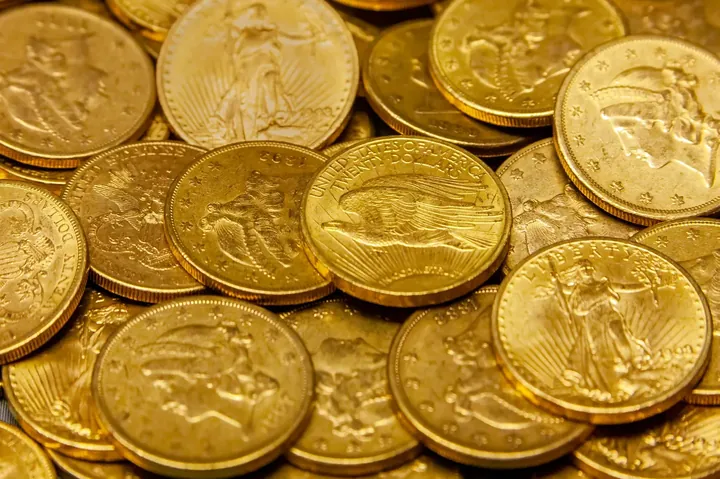
Many Cincinnati families of German descent kept gold the way their grandparents did in Europe: a few coins in a safe, saved for hard times and rarely talked about. We see U.S. double eagles next to German 20 mark pieces and the occasional Austrian ducat.
Others bought bullion coins in the late 1970s and again after 2008. Whatever the story, every coin gets weighed, measured and checked in front of you.
Pre-1933 U.S. gold
Before 1933, gold coins circulated as everyday money. After the government recalled them, many families kept a few anyway, and those coins still come out of safes and safe deposit boxes all over Greater Cincinnati.
Double eagles are the most common, followed by half eagles and eagles. Quarter eagles and gold dollars are smaller and turn up less often. Nearly all sell above their gold value, and some sell far above it.
European gold
Because so many Cincinnati families came from Germany and Central Europe, we see more European gold here than in most cities. Here is what turns up most.
- German 10 and 20 mark coins from 1871 to 1915
- Austrian 1 and 4 ducats, often restrikes
- Austrian 100 corona restrikes
- French 20 franc Roosters and Napoleons
- Swiss 20 franc Helvetia coins
- British sovereigns
Restrikes and originals
Austria and some other countries restruck older gold coin designs for decades as a way to sell gold. Restrikes are real gold and sell close to their gold value. Original strikes can carry collector premiums. We tell you which is which and price each one on its own terms.
Payment for gold coin sales
Gold coin sales can add up fast. Tell us roughly what you have when you book, and we can plan a same-day bank wire. The written offer lists every coin with its gold content, the spot price we used and our price.
Fractional and proof gold
Many people bought gold a little at a time: tenth and quarter ounce Eagles, small Maple Leafs, gram bars. We weigh each coin and price it on its exact gold content, so the small ones get the same care as the big ones.
Proof gold from the U.S. Mint comes in velvet boxes with certificates. Keep everything together. A proof coin in its original box often sells for more than the same coin loose.
Gold coins in jewelry
Double eagles and smaller gold coins were often mounted in bezels and worn as pendants. A mounted coin can still be sold. Bezels and solder leave marks, so most mounted coins sell close to their gold value, and the mount is priced on its own karat.
Gold coins we buy
- Liberty and Saint-Gaudens double eagles
- Indian Head and Liberty half eagles and eagles
- Quarter eagles and gold dollars
- American Gold Eagles and Buffalos
- Krugerrands and Maple Leafs
- German 10 and 20 mark gold coins
- French, Swiss and British gold coins
- Proof gold in original Mint boxes
How gold coins are priced
Every gold coin starts with the pure gold it holds, priced at the live spot price during your appointment. A one ounce bullion coin holds one troy ounce of gold. A pre-1933 double eagle holds a little under an ounce.
Older U.S. gold usually sells for a premium over its metal. Scarce dates, branch mint coins and high grades can sell for much more. We list the gold value and the premium separately on the offer.
Further reading: Old German coins and marks: what they are worth
Common questions
- Do you buy German gold coins?
- Yes. German 10 and 20 mark gold coins sell on their gold content, and some states and dates carry collector premiums.
- Do you buy fractional gold?
- Yes. Tenth, quarter and half ounce coins are priced on their exact gold content.
- How do you check for fakes?
- We check weight, size and thickness against published specifications and use testing that does not harm the coin.