Selling old coins in Cincinnati
Coin folders, jars, rolls and loose coins. We separate the silver, grade the better dates and tell you plainly what is common.
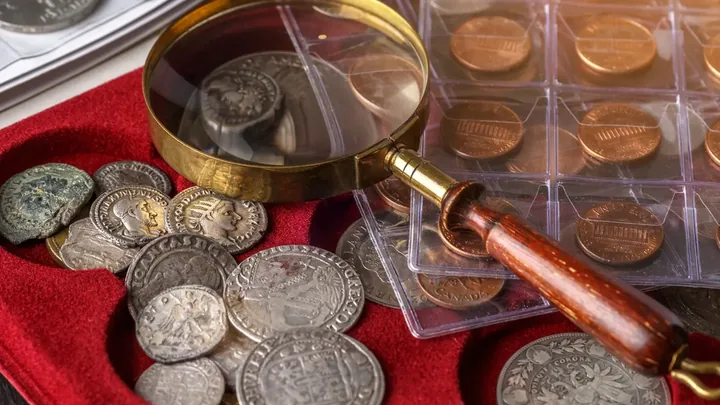
Old coins from Cincinnati homes
A lot of the coins we see in Cincinnati were set aside by people who handled cash every day: shopkeepers in Over-the-Rhine, bartenders, streetcar conductors, workers at the old machine tool shops in Oakley and Norwood. When silver left circulation in the 1960s, many of them pulled it from their change and kept it.
Those jars and folders are still in basements and closets all over the city. Most of what is inside is common, but there is usually some silver, and every so often a coin that deserves a closer look.
Sorting a jar of old change
Most jars and cans we open in Cincinnati follow the same pattern. The bulk is copper cents from the 1940s and 1950s. Mixed in are some nickels, a handful of silver dimes and quarters, maybe a few halves, and once in a while something older that nobody can identify.
We sort the jar by metal first. Silver goes into one pile, copper and nickel into others. Then we look through each pile for dates and mint marks that collectors pay extra for. Only after that do we price the silver by weight and count the rest.
Coins worth a closer look
A few kinds of coins earn a second look every time. None of them are guaranteed winners, but each one can be.
- Indian Head cents, especially 1877 and 1908-S and 1909-S
- Buffalo nickels with a full date
- Mercury dimes from 1916-D, 1921 and 1921-D
- Standing Liberty quarters with a clear date
- Barber halves in better grades
- Two cent pieces from the 1860s
- Proof coins still in their original cellophane
Coins from overseas
Cincinnati collections hold more European coins than most. German, Austrian, Swiss and Italian coins came over with immigrant families, and later generations added coins from military service and travel.
Silver and gold world coins sell on their metal, and some carry collector premiums. Most base metal world coins are worth very little. We sort them by country and metal and tell you plainly which ones matter.
What happens if you want to keep some
Plenty of sellers keep a birth year coin, a set a parent assembled or a coin with a story. That is fine. The written offer lists each piece or group, so you can pick what to sell and leave the rest. The price on the coins you do sell does not change.
Mint marks, and where to find them
A mint mark is a small letter showing where a coin was struck: D for Denver, S for San Francisco, O for New Orleans, CC for Carson City. Coins struck in Philadelphia often carry no mark at all. The same date can be common from one mint and scarce from another.
On wheat cents the mark sits under the date. On Mercury dimes it is on the back, near the bundle of sticks at the bottom. On Walking Liberty halves before 1917 it can be on the front. We check every one, so you do not need to sort them yourself.
Proof sets and mint sets
The Mint has sold proof sets and mint sets to collectors for decades, and Cincinnati families bought a lot of them. Sets from 1964 and earlier contain 90 percent silver coins. Silver proof sets from 1992 on carry silver too. Clad sets from 1968 through 1991 usually sell close to face value.
Leave them in their original packaging. We sort them by year and type and price each group.
Coins we buy
- Indian Head and wheat cents
- Buffalo and early Jefferson nickels
- Barber, Mercury and Roosevelt dimes through 1964
- Standing Liberty and Washington quarters through 1964
- Walking Liberty, Franklin and Kennedy halves
- Two cent and three cent pieces
- German, Austrian and other European coins
- Proof sets and mint sets
How old coins are priced
Every coin has a floor set by its metal. U.S. dimes, quarters and halves from 1964 and earlier are 90 percent silver, so they always carry silver value. Copper and nickel coins have a floor of face value or a little more.
Above that floor, date, mint mark and grade decide the price. We check each candidate coin under magnification and price the better ones individually.
Further reading: What is a wheat penny worth?
Common questions
- Are my wheat pennies worth anything?
- Most are worth a few cents each. A few dates and mint marks, like the 1909-S VDB, 1914-D and 1931-S, are worth much more, and we check for them.
- Do you buy coins in folders?
- Yes. Please leave them in the folders. We look at each coin in place.
- Should I clean my coins?
- No. Cleaning lowers the value of old coins. Bring them as they are.